

Hate having your picture taken? How to take a good LinkedIn photo anyway, step by step.
A good LinkedIn photo is a well-lit, correctly framed shot of your face with a genuine expression, and you can get one even if you dread the camera because the discomfort is a solvable problem, not a personality flaw. If you would rather skip the trial and error entirely, LinkedIn headshots in Fort Myers at JA Headshots are built specifically for people who say they hate photos, and this guide breaks down exactly how to get a photo that works, whether you do it yourself or book a session.
Why does the LinkedIn photo matter more than people think?
Because on LinkedIn your photo is often the very first thing anyone processes about you, and they process it in a fraction of a second. A recruiter scanning a list of candidates, a prospect deciding whether to reply to your message, a hiring manager glancing at your profile before a call, all of them see your face before they read your headline. The photo is doing work whether you planned for it or not.
The speed of that judgment is well documented. In a 2006 study published in Psychological Science, Princeton psychologists Janine Willis and Alexander Todorov found that people form impressions of a face on traits like trustworthiness and competence after as little as one-tenth of a second, and that longer viewing mostly just hardened the snap judgment they had already made. That is the exact moment your LinkedIn photo is competing in. You do not get to explain the photo first, so the photo becomes the explanation.
Here is the honest part: that research is about faces in general, not a promise that a better photo will raise your reply rate by some specific percentage. Anyone quoting you a precise number is guessing. What the science does establish is that the first impression happens fast and sticks, which is exactly why it is worth getting the controllable parts, light, framing, and expression, right instead of leaving them to chance.
What actually makes a LinkedIn photo look good?
Four things, and the camera is the least important of them. If you nail these, a modern phone will do beautifully. If you miss them, no camera will save the shot.
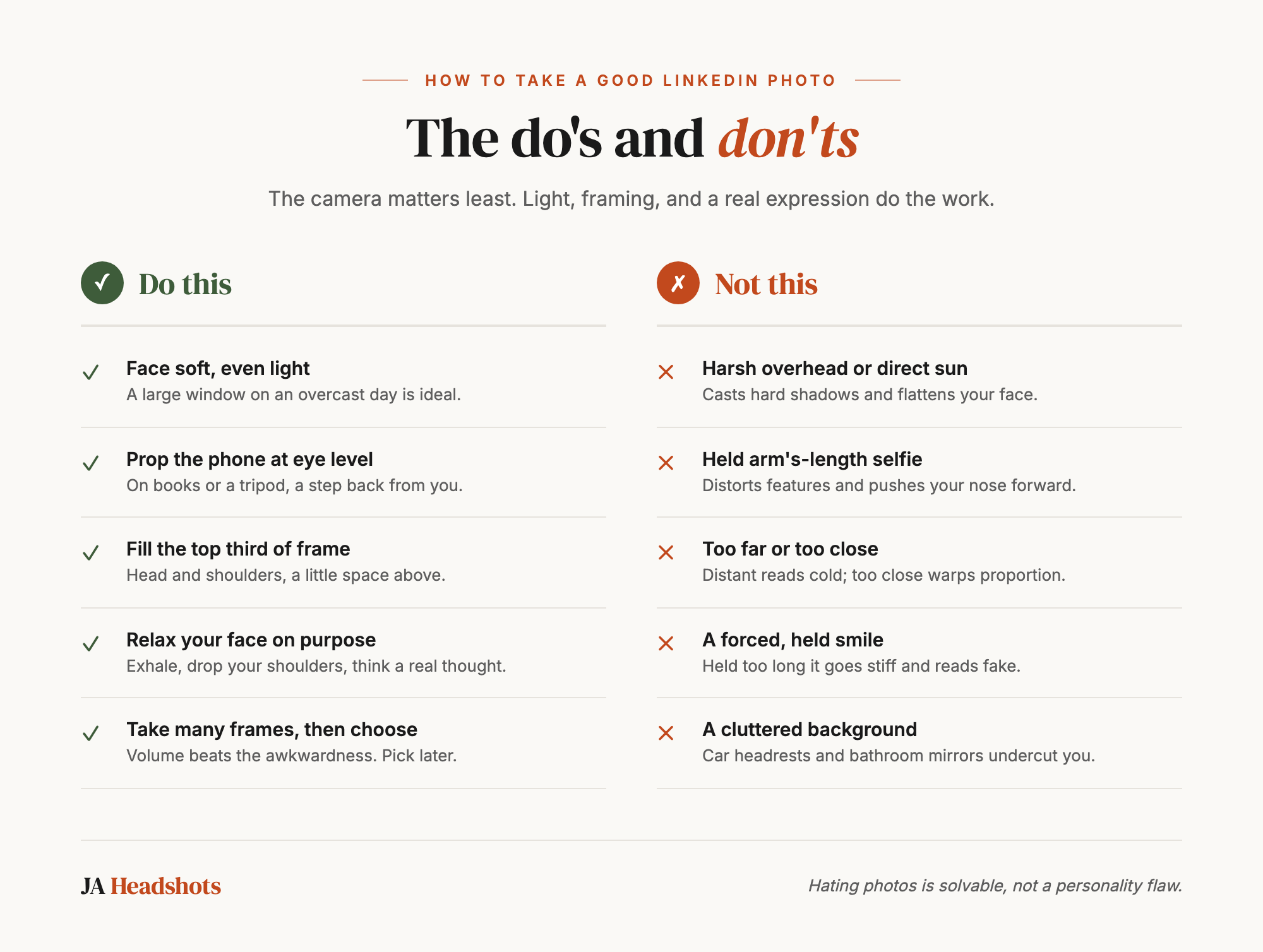
- Light on your face. Soft, even light is the single biggest factor. It flatters your features, softens shadows, and gives your skin dimension. Harsh overhead office light and direct sun are the usual culprits behind an unflattering photo.
- Framing. Your head and shoulders should fill roughly the top third of the frame, with a little space above your head and your eyes about a third of the way down. Too far away reads distant; too close distorts your face.
- A clean background. A simple, uncluttered backdrop keeps the focus on you. A busy room, a car headrest, or a bathroom mirror quietly undercuts the professional read.
- A genuine expression. A real, relaxed expression beats a forced grin every time. This is the hardest part to fake and the part most worth slowing down for.
Notice the camera is not on that list as a make-or-break item. A good phone in good light beats an expensive camera in bad light, which is freeing, because it means the tool in your pocket is enough to get most of the way there.
How do I take a good LinkedIn photo myself, step by step?
You can get a genuinely usable LinkedIn photo at home with a phone and a window. Here is the method, in order.
- Find soft, even light. Stand facing a large window during daylight, with the light coming toward you, not behind you. Overcast days are ideal because the light is soft. Avoid direct sun and overhead lighting, both of which cast harsh shadows.
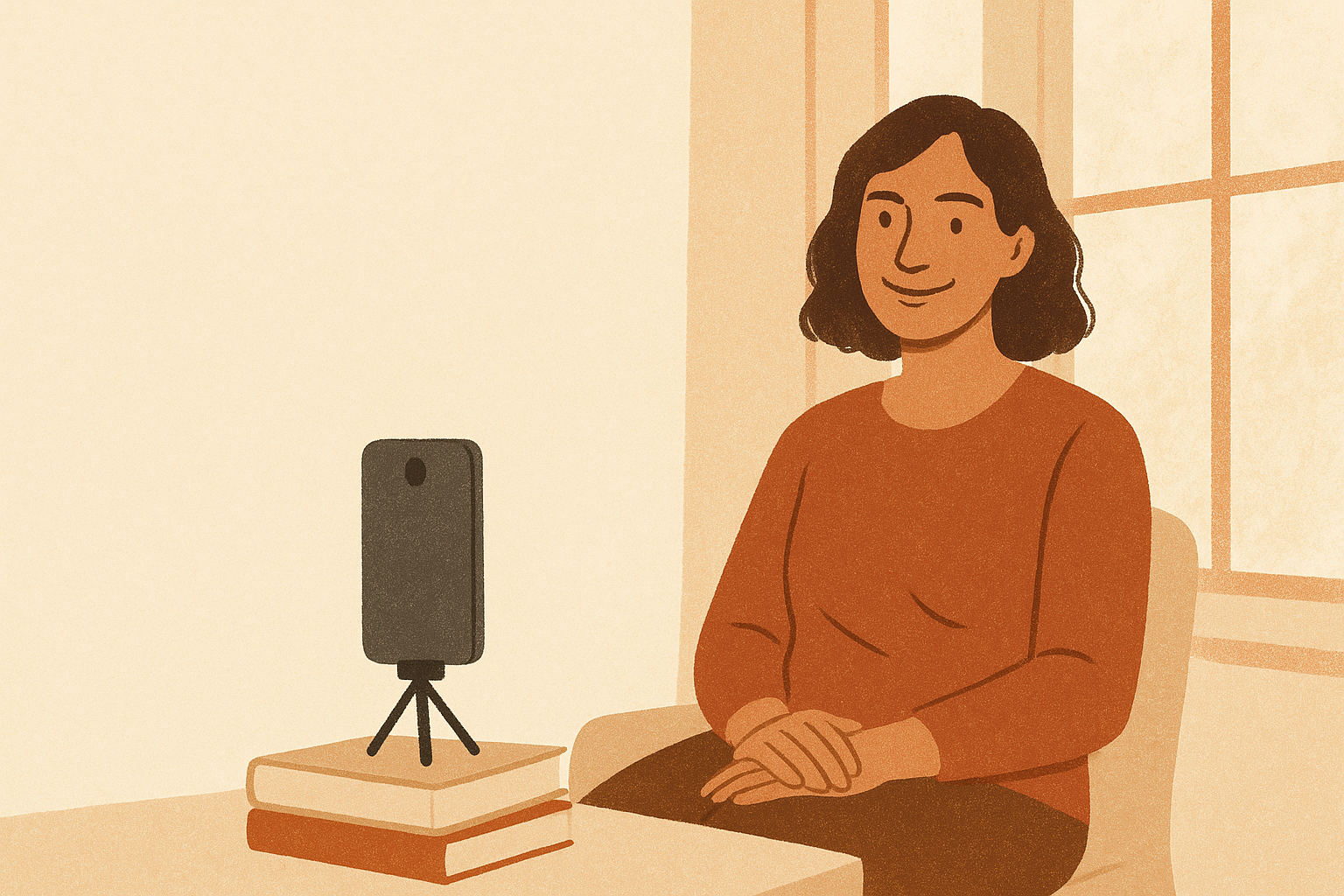
- Prop the phone at eye level. Do not hold it. Rest it on a shelf, a stack of books, or a small tripod so the lens sits at roughly eye height and a step back from you. Holding a phone at arm's length distorts your features and pushes your nose forward.
- Use the timer or a helper. A self-timer or a burst mode lets you relax your arms and your face instead of straining to reach the button. If a friend can shoot, even better, but props work fine.
- Clean up the background. Point yourself at the simplest wall or view available. A plain background almost always beats an interesting one for a profile photo.
- Relax your face on purpose. This is the step people skip. Exhale slowly right before the shot, drop your shoulders, and think of something specific and pleasant rather than commanding yourself to smile. A real thought produces a real expression.
- Take many frames, then choose. Do not aim for one perfect shot. Take dozens, change your expression slightly between them, and pick your favorite later. Volume is how you beat the awkwardness.
That method will get most people a solid, honest LinkedIn photo. The remaining gap, and there usually is one, comes down to the things that are genuinely hard to control alone: shaping the light, hitting natural expression on demand, and directing yourself out of stiffness.
What if I genuinely hate having my picture taken?
Then you are in the majority, and the fix is direction, not willpower. Most people who say they are not photogenic are not fighting their face; they are fighting the awkwardness of standing in front of a camera with no idea what to do. That awkwardness is what shows up in bad photos, and it is exactly what a good process removes.
The discomfort usually comes from a few specific things: not knowing what to do with your hands, holding a smile so long it goes stiff, and having no feedback on whether it is working. Every one of those is solvable. When you do it yourself, you solve them with volume and a relaxed setup. When you book a session, a photographer solves them by directing you into an expression and posture that read natural, giving you real-time feedback, and simply removing the burden of self-monitoring. Our entire LinkedIn headshot approach in Fort Myers is built around this, because the recruiter-scan moment is too important to leave to a stiff, guessed-at photo.
The reframe that helps most people: you do not need to become someone who loves the camera. You need a process that gets a good photo out of someone who does not. That is a much smaller, much more achievable goal.
It also helps to know that consistency matters as much as any single shot. A selfie is a one-off that varies every time you take it, so your photos across LinkedIn, your company site, and your email signature end up looking like different people. A guided session gives you a matched set from one sitting, which is part of why teams book corporate headshots in Fort Myers together rather than letting everyone submit a different phone photo. One good afternoon solves the problem across every platform at once.
Should I just book a professional session instead?
If the photo is doing real work for your career and self-shooting keeps producing results you do not like, yes. A professional session is not a luxury here; it is the shortcut past the exact problems that make LinkedIn photos hard.
A good session controls the four things that decide how your face reads, light, framing, background, and expression, so none of them are left to luck. You get direction the whole way, so you are never standing there wondering what to do with your hands. With unlimited session time there is no clock forcing a rushed frame, and professional retouching is included so the final image looks polished without looking edited. For people who dislike photos, that combination, real direction plus no time pressure, is what turns "I hate every photo of me" into a shot they are happy to put online.
Pricing is transparent. Our individual headshot pricing in Fort Myers is a flat $500 session fee plus $150 per fully retouched image you choose to keep, with no hidden costs and standard delivery in 48 to 72 hours. You get a set of images built for LinkedIn, your website, and anywhere else your face needs to earn trust, and the awkward part is handled for you.
The questions we hear most about LinkedIn photos, answered in plain language.
Ready for a LinkedIn photo you actually like?
You do not have to love the camera to end up with a photo that works. If your current profile photo is a cropped group shot, a distorted selfie, or nothing at all, book LinkedIn headshots with JA Headshots in Fort Myers and get a portrait built for the moment a recruiter reads your face in a fraction of a second. Sessions are guided start to finish, retouching is included, and there is no clock on your time. Call (239) 401-6999 to book.
This article was written by Joshua Albanese, founder and lead photographer at JA Headshots in Fort Myers. He founded a top-10 US headshot studio in Chicago, photographed more than 15,000 professionals over 18 years, and relocated to Southwest Florida in 2024. His psychology-driven approach is built for people who are convinced they are not photogenic.
Frequently asked questions
How do I take a good LinkedIn photo if I hate having my picture taken?
Start by accepting that hating photos is normal and solvable, not a fixed trait. Use soft, even light like a large window, hold the camera at eye level and a step back, and give yourself a real reason to relax your face, like exhaling slowly or thinking of something specific. Take many frames, not one. If self-directing still feels impossible, a guided session removes the guesswork entirely, which is the whole point of professional direction.
What makes a LinkedIn photo look professional?
Four things: good light on your face, correct framing that fills roughly the top third with your head and shoulders, a clean uncluttered background, and a genuine expression rather than a forced smile. The camera itself matters least. A modern phone in good light beats an expensive camera in bad light every time.
Should my LinkedIn photo be a selfie?
For a personal social account a selfie is fine, but LinkedIn is where strangers decide whether to trust you professionally, so it deserves better than an arm's-length phone shot. A selfie distorts your features and usually reads casual. If you cannot get a proper photo, a self-timed shot on a propped phone at eye level beats a held selfie, and a professional session beats both.
How often should I update my LinkedIn photo?
Update it when your appearance has changed enough that people might not recognize you, or roughly every two to three years. The photo should look like you on a normal good day. If you changed your hair, your glasses, or your role, it is time for a refresh.
Do I need a professional photographer for a LinkedIn photo?
Not strictly, but it helps more than most people expect, especially if you dislike being photographed. A photographer controls the light, the framing, and your expression, and directs you the whole way so you are never left guessing. The difference on LinkedIn, where a recruiter reads your face in a fraction of a second, is the difference between reading as a credible professional and reading as a placeholder.
LinkedIn headshots in Fort Myers, built for the recruiter-scan moment. Guided, retouched, no clock.
Learn more
Written by
Joshua Albanese
Photographer, JA Headshots
Joshua Albanese founded one of the top-10 rated headshot studios in the United States in Chicago in 2007. Over 18 years he photographed more than 15,000 professionals and produced over 3 million images for clients ranging from Fortune 500 executives to first-year associates. In 2024 he relocated to Fort Myers and opened a dedicated portrait studio at 1325 Canterbury Dr. His psychology-driven approach is built for people who say they aren't photogenic.